0086-18218346058 info@qiruisafe.com
0086-18218346058 info@qiruisafe.com
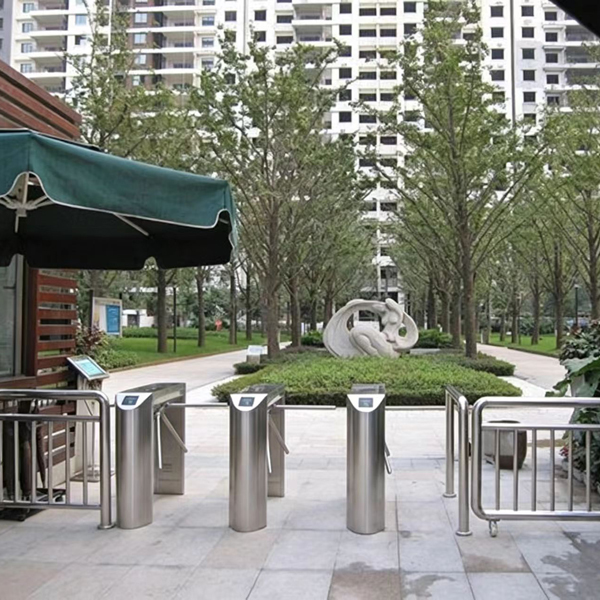
For residential communities, the tripod turnstile is not a high-tech luxury but a pragmatic, cost-effective solution for basic pedestrian access control. Its core value lies in enforcing "one person per swipe" to deter tailgating, combined with a mechanical design that is simple, durable, and easy to maintain. However, it is crucial to recognize its limitations: standard models are not designed for strollers, wheelchairs, or large deliveries, and the semi-automatic version requires a slight manual push, which may not suit every resident's preference.
The primary appeal for property managers is the balance between security and cost. Unlike swing gates or speed gates, tripod turnstiles feature a purely mechanical or semi-automatic movement that is robust and less prone to electronic failure. For a residential community where traffic is moderate (typically 25–35 people per minute) and the budget is a concern, this is often the most viable option .
The inherent "anti-tailgating" design is a significant advantage. The three rotating arms create a physical barrier that only allows one person to pass per authorization. This prevents unauthorized individuals from slipping in behind a resident, a common issue in communities with simple swinging doors . Furthermore, modern units can easily integrate with existing access control systems, whether residents use RFID cards, facial recognition, or smartphone QR codes, making it a flexible upgrade for older communities looking to modernize .
When specifying a unit for a community, buyers should focus on a few critical parameters to avoid costly mistakes.
Semi-Automatic vs. Fully Automatic: For most residential settings, a semi-automatic model is sufficient. It requires the user to gently push the arm after verification. This mechanical reset is highly reliable and keeps costs down. Fully automatic models offer a smoother, "hands-free" experience (the arm rotates automatically) and higher throughput, but they come at a higher price and introduce more electronic components that could fail . Unless the community has exceptionally high foot traffic, the semi-automatic variant is the practical choice.
Material and Weather Resistance: Since community entrances are often semi-outdoor or fully exposed, the housing must be durable. Look for 304 stainless steel construction, which offers excellent corrosion resistance and will maintain its appearance over years of exposure to the elements. Cheaper 201 stainless steel or painted iron is prone to rust and will look shabby quickly . Additionally, check the IP rating; for outdoor installation, an IP54 rating or higher is essential to prevent dust and water ingress from jamming the mechanism .
Passage Width and Accessibility: This is a critical pain point. Standard tripod turnstiles have a passage width of around 550mm to 600mm, which is suitable for average pedestrians but not for wheelchair users, people with large luggage, or parents with strollers . To address this, communities should plan for an accessible lane parallel to the turnstiles. This could be a wider swing gate or a dedicated staffed gate that can be opened for individuals with mobility needs or large items .
While cost-effective, the tripod turnstile has a distinct "feel" that some residents may find less welcoming than a sleek speed gate. The pushing motion and the physical arms can feel institutional. However, for many communities, this trade-off is acceptable for the security and durability provided.
Installation requires a flat, solid surface (usually a concrete foundation) and access to power and networking for the access control readers. Property managers should also ensure that the fire alarm system is linked to the turnstile controller. In an emergency, the turnstile arms must automatically drop (or be easily released) to allow for unimpeded evacuation . Regular maintenance is minimal but necessary; the mechanism should be checked periodically to ensure the damping system is smooth and the arms drop freely when powered down.
In summary, a tripod turnstile is a sound investment for a residential community seeking to tighten pedestrian security without undertaking a major renovation or spending on high-end speed gates. By selecting a 304 stainless steel semi-automatic model with an appropriate IP rating and ensuring a separate accessible lane is available, property managers can achieve reliable, "one-person-one-swipe" access control that will serve the community for years.